
CSAM Celebrates Partnership with Kazakh National Agrarian Research University to Promote Sustainable Agricultural Mechanization
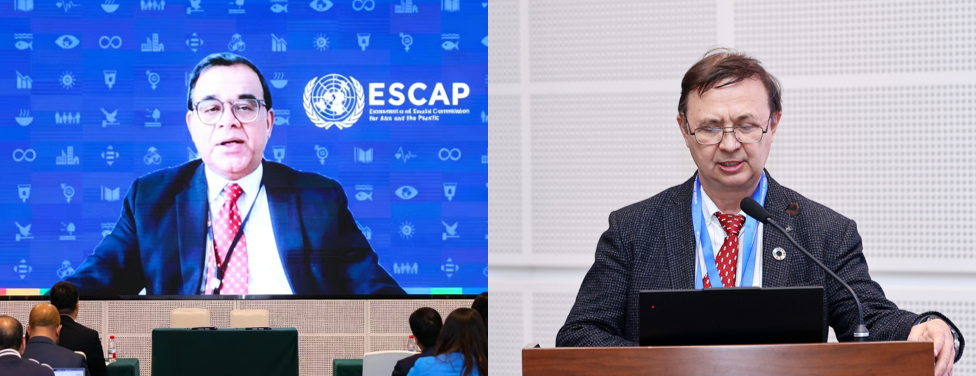
On 26 October 2026, the Centre for Sustainable Agricultural Mechanization (CSAM) of the United Nations Economic and Social Commission for Asia and the Pacific (ESCAP) organized a ceremony to celebrate the signing of the Memorandum of Agreement between the United Nations Economic and Social Commission for Asia and the Pacific (ESCAP) and the Kazakh National Agrarian Research University (KazNARU). The ceremony was held during the Eleventh Regional Forum on Sustainable Agricultural Mechanization in Asia and the Pacific alongside the 2026 China International Agricultural Machinery Exhibition (CIAME) in Tianjin, China.
Mr. Srinivas Tata, Director of ESCAP’s Strategy and Programme Management Division, addressed the participants through a video, followed by Professor Rafis Abazov, Vice-Rector of KazNARU. They underscored the significance of the partnership and the shared commitment of ESCAP and KazNARU to advancing sustainable agricultural mechanization, innovation, and regional cooperation.
Under the Memorandum, ESCAP, through CSAM, and KazNARU will leverage their respective strengths, expertise, and networks to advance sustainable agricultural mechanization. Both parties are committed to strengthening cooperation to promote innovative and proven sustainable agricultural mechanization technologies and practices through joint training activities, research collaboration, knowledge sharing and information exchange, and mutual support for technology innovation and development in the Asia-Pacific region and particularly Central Asia sub-region.
KazNARU is a leading higher education institution in Kazakhstan, specializing in agricultural sciences, technological research, education and innovation. Since 2025, CSAM has collaborated with KazNARU on several initiatives, including joint research activities and efforts to strengthen regional cooperation. This collaboration highlights the important role of academic and research institutions in fostering regional collaboration, knowledge exchange and the adoption of sustainable mechanization-based solutions across the region.