
Twenty-first Session of the Governing Council of CSAM Commends Achievements of the Centre and discusses AI applications in mechanization
Meeting Documents
The twenty-first session of the Governing Council of the Centre for Sustainable Agricultural Mechanization (CSAM) was held on 26 November 2025 in Vientiane. As per the statute of CSAM, the Governing Council meets annually to review the activities, administrative and financial status of CSAM, and to provide guidance for CSAM’s work plan.
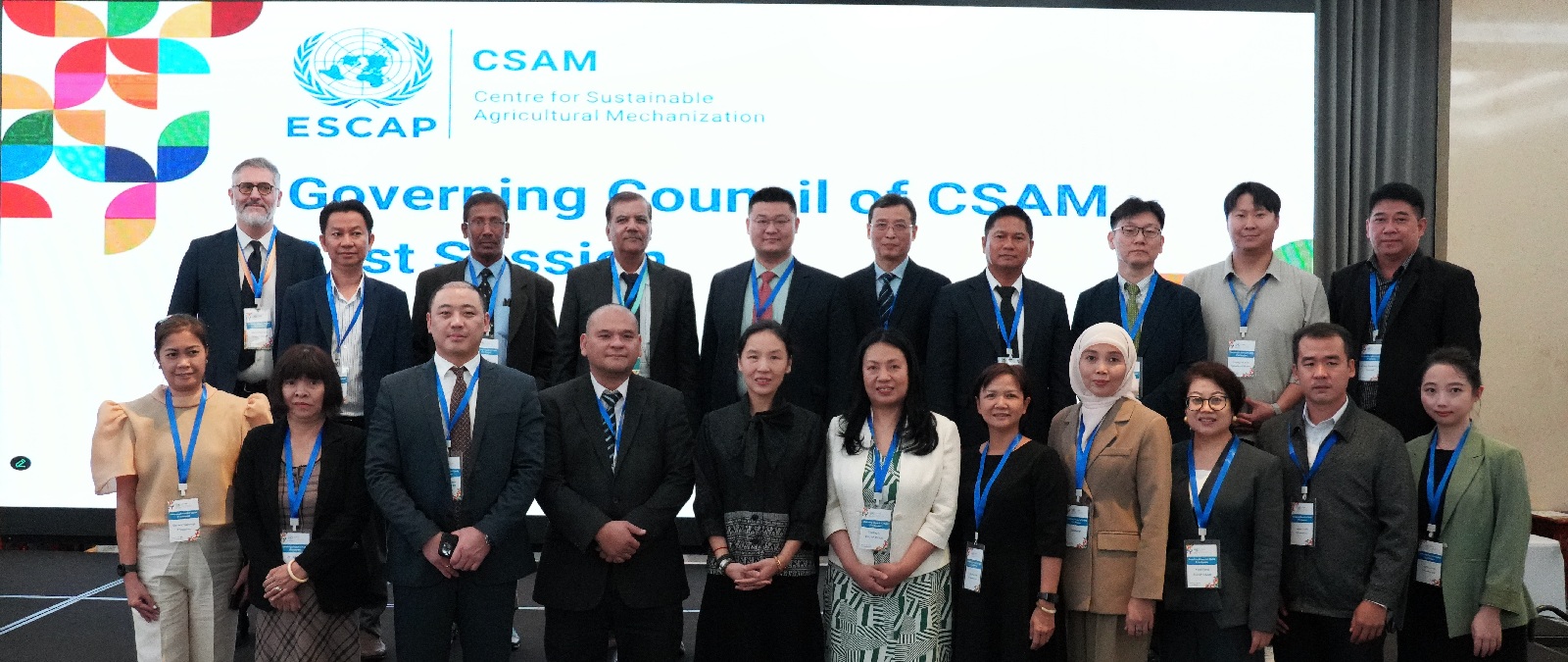
All nine members of the Governing Council, namely China, India, Malaysia, Mongolia, Philippines, Republic of Korea, Sri Lanka, Thailand and Viet Nam, attended the session, joined by representatives from Cambodia and Lao PDR who attended the meeting as observers. The Governing Council elected Mr. Badril Hisham Bin Abu Bakar, Deputy Director at the Malaysian Agricultural Research and Development Institute, as Chair, and Mr. Bayarsaikhan Dangaasuren, an expert with the Policy and Planning Department of Mongolia's Ministry of Food, Agriculture and Light Industry, as Vice Chair.


Ms. Lin Yang, Deputy Executive Secretary of ESCAP, in her opening remarks highlighted the region’s megatrends, from energy transition to demographic shifts, and the need to reaccelerate productivity. She underscored that the digital transformation and the integration of new technologies in agricultural mechanization could be one of the new drivers for growth, enhancing the efficiency of farming practices, and creating conditions where older population can safely and meaningfully contribute, while attracting younger population to join the food production journey.
During the discussions, the Governing Council commended the achievements and many initiatives of CSAM in 2025, and recognized the importance of sustainable agricultural mechanization to achieve the 2030 Agenda for Sustainable Development. The Council also discussed the topic of artificial intelligence and technological innovations for sustainable agricultural mechanization through an informal session moderated by the secretariat, with an overview of related national strategies and policies as well as opportunities and barriers for regional cooperation. The Governing Council members highlighted the importance of supporting the adoption of new technologies through addressing the digital gap of some developing countries or remote regions, particularly through education and training; and recommended that the Centre serve as a platform for sharing leading technologies and advancements and analyze their success and failure factors.
The Council also encouraged the Centre to continue its positive work on sustainable agricultural mechanization for poverty alleviation and rural development guided by the five priority areas identified in its 2025-29 strategy and to explore opportunities to further support member States in addressing their needs.